In ten weeks, sending money out of Tennessee will cost more than sending it out of any other state. Almost nobody is writing about it, and the parts that matter most are the parts going unreported.
What the law actually does?
Tennessee's HB 2502, signed in May 2026, applies from 1 January 2027. The structure is two charges stacked on one transfer:
- A flat $10 on every cross border payment, regardless of size
- An additional 2 percent on any transfer above $500
A worker sending $300 home pays $10, which is 3.3 percent of the amount sent, before any provider fee or exchange rate margin. Someone sending $1,000 pays $10 plus $20, so $30, which is 3 percent. The flat component means the burden falls hardest on the smallest transfers, which is to say on the people least able to absorb it.
Tennessee's own Fiscal Review Committee put the expected yield at roughly $54.8 million a year, based on about 16.3 million transfers worth $5.5 billion.
The part that is not being reported
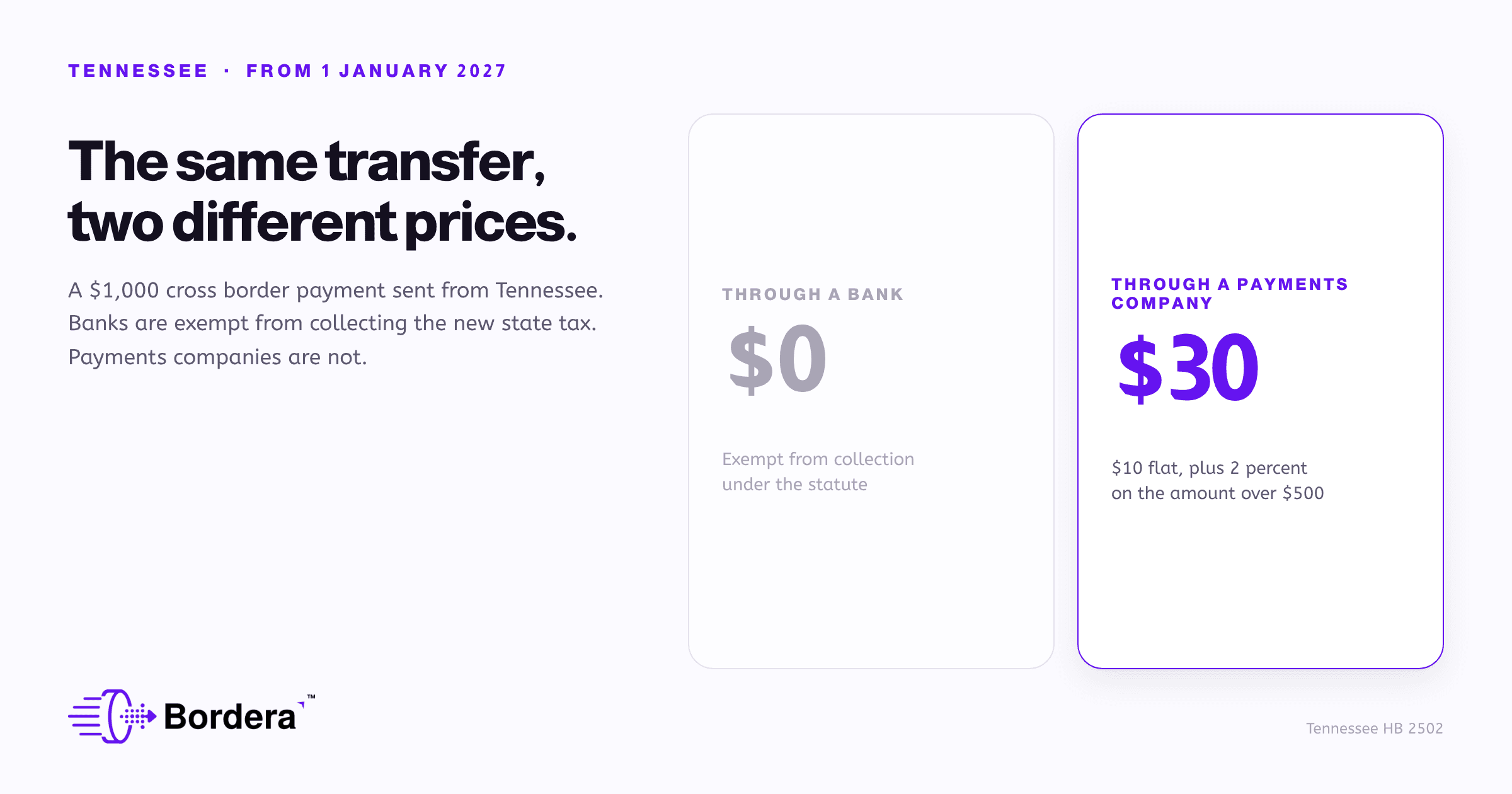
Banks are exempt from collecting it.
The obligation to identify a qualifying transfer, calculate the charge, collect it from the sender and remit it to the state sits with payments companies and money transmitters. A customer who sends the same $1,000 through a bank wire pays nothing. The same transfer through a licensed money transmitter carries $30.
That is not a side effect. It is a structural advantage written into the statute, handed to the institutions that already dominate the expensive end of the market and withheld from the companies competing on price.
For a payments business, the operational question is not the money. It is that an entirely separate collect and remit pipeline now has to exist for one state, with sender location determined reliably enough to defend in an audit.
The legal challenge has not been resolved
The Financial Technology Association filed suit in June 2026, arguing the tax violates the dormant commerce clause and the import export clause of the US Constitution. As of late October, no ruling has been reported.
The only real precedent is Oklahoma, which has levied a fee on wire transfers since 2009 and has survived. Oklahoma's structure is different enough that it does not settle the question.
So a tax with an effective date ten weeks away is still subject to an unresolved constitutional challenge. Providers have to build for it anyway. You cannot tell a state regulator in February that you did not collect because you expected a court to strike the statute down.
What it means if you send money from Tennessee
Three practical points.
Check how your provider displays it. Under the federal remittance transfer rules a provider has to disclose the total cost before you confirm. A charge added at the end, after the quoted rate, is still a cost you are paying.
The charge may depend on how you send, not just where from. The federal excise tax that came in this January exempts transfers funded from a bank account or a card. Tennessee's law is written differently and turns on the type of institution rather than the funding method. Read both.
Splitting a transfer does not help. Two $400 transfers avoid the 2 percent band but incur $10 twice. At $800 total you pay $20 either way.
What it means for the category
The federal tax that took effect in January is, for most digital senders, avoidable by funding method. State taxes are not, because they attach to who is moving the money rather than how it was funded.
If Tennessee survives the challenge, other states will follow, and the compliance surface for a cross border payments company stops being one federal rule and becomes fifty possible ones. That is the real cost, and it lands on small companies far harder than large ones.
Where we sit
Bordera is pre launch, building cross border payments for the US to India and US to Philippines corridors. We are not operating in Tennessee or anywhere else yet. We are reading these rules now because the cost of understanding them after launch is considerably higher.
We will publish an update when the court rules.
Sources
Payments Dive, Tennessee levies tax on remittances: https://www.paymentsdive.com/news/tennessee-levies-tax-on-remittances/821185/
American Banker, Tennessee remittance tax faces constitutional challenge: https://www.americanbanker.com/payments/news/tennessee-remittance-tax-facesconstitutional-challenge
Financial Technology Association, lawsuit announcement: https://www.ftassociation.org/ftafiles-lawsuit-challenging-constitutionality-of-tennessee-cross-border-payments-tax/
Last reviewed 23 October 2026. This is general information about published law and not tax or legal advice.